Microhmmeters
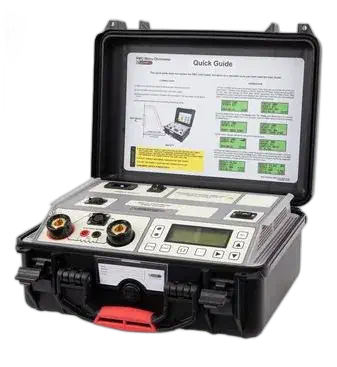
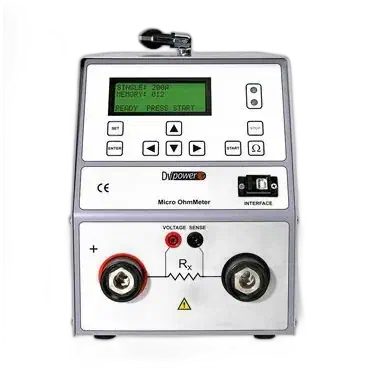
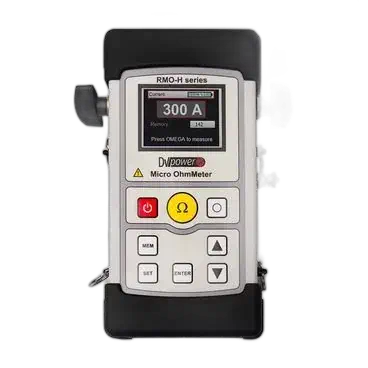
Micro-ohmmeters measure the contact resistance of the main circuit of circuit breakers, disconnectors, busbars and joints, with resolution down to 0.01 µΩ. It is the most direct way to know whether a contact is healthy: rising resistance means heating, losses and, eventually, failure.
What does it measure and how does it work?
Mechanical wear, heat and arcing reduce the effective contact area and leave carbonised layers; resistance rises (R = ρ · l / S) and losses rise with it, P = I² · R. At 1 kA, a 100 µΩ contact dissipates 100 W at a single point; if its resistance reaches 1 mΩ it dissipates 1 kW, enough to overheat it. The micro-ohmmeter injects a high direct current and measures the voltage drop with the 4-wire Kelvin method, which cancels the resistance of the leads. Ohm’s law alone would suggest a small current is enough, but a high current breaks through surface contamination and gives more accurate, repeatable readings.
How to choose the right equipment
- Test current: IEC 62271-1 calls for at least 50 A and IEEE C37.09 for 100 A; for contacts with high resistance, more than 100 A is advisable.
- Both sides earthed: measuring with the breaker earthed on both sides, using a clamp meter, is safe practice in substations. The RMO-G series allows it, from 100 to 800 A in an IP67 case.
- Pure direct current: the RMO-A reaches 600 A from 0.1 µΩ and weighs only 7–8 kg.
- Portability: the RMO-H weighs 0.95 kg, regulates 1 to 300 A from a Li-Po battery and sends data via Bluetooth.
- Leads: short to measure from the crane basket, long to measure from the ground, or Kelvin probes with a trigger button.
- Look for accuracy of around ±(0.1 % of reading + 0.1 % of full scale).
Not sure which model? Please get in touch.
Applications
- Contact resistance of HV and MV circuit breakers in maintenance and commissioning
- Disconnectors, busbars, bolted joints and welds
- Cable connections, battery links and earth conductors
Applicable standards
- IEC 62271-1 — measurement of main-circuit resistance (≥ 50 A DC)
- IEC 62271-100 — high-voltage alternating-current circuit breakers
- IEEE C37.09 — circuit breaker testing (≥ 100 A)
- IEC/EN 61010-1 — instrument safety
Frequently asked questions
Why is an ordinary ohmmeter not enough?
Because the values are tens of micro-ohms: with two wires and low current, the leads and surface contamination distort the reading.
What value is acceptable?
It is compared with the manufacturer’s value and with the previous measurement of the same pole; a clear increase or a marked difference between poles points to a degraded contact.
Why measure with both sides earthed?
For safety: it avoids induced voltages in live substations. The current flowing through the earth is compensated by measuring with a clamp.
Technical resources
Combine contact resistance with circuit breaker testing and ohmmeters. Request a quotation.